Blog · Errors, prevented

How to reduce manufacturing errors before production starts

The most expensive manufacturing errors are decided before anything is cut: in the quote, the spec, and the sales to production handoff. The factory then builds exactly what was ordered, and the argument that follows is about who owned the measurement, not who ran the saw. This guide walks the error upstream and lists the controls that stop it at entry.

Teodoro PickettBy Teodoro Pickett·Last updated 11 min read
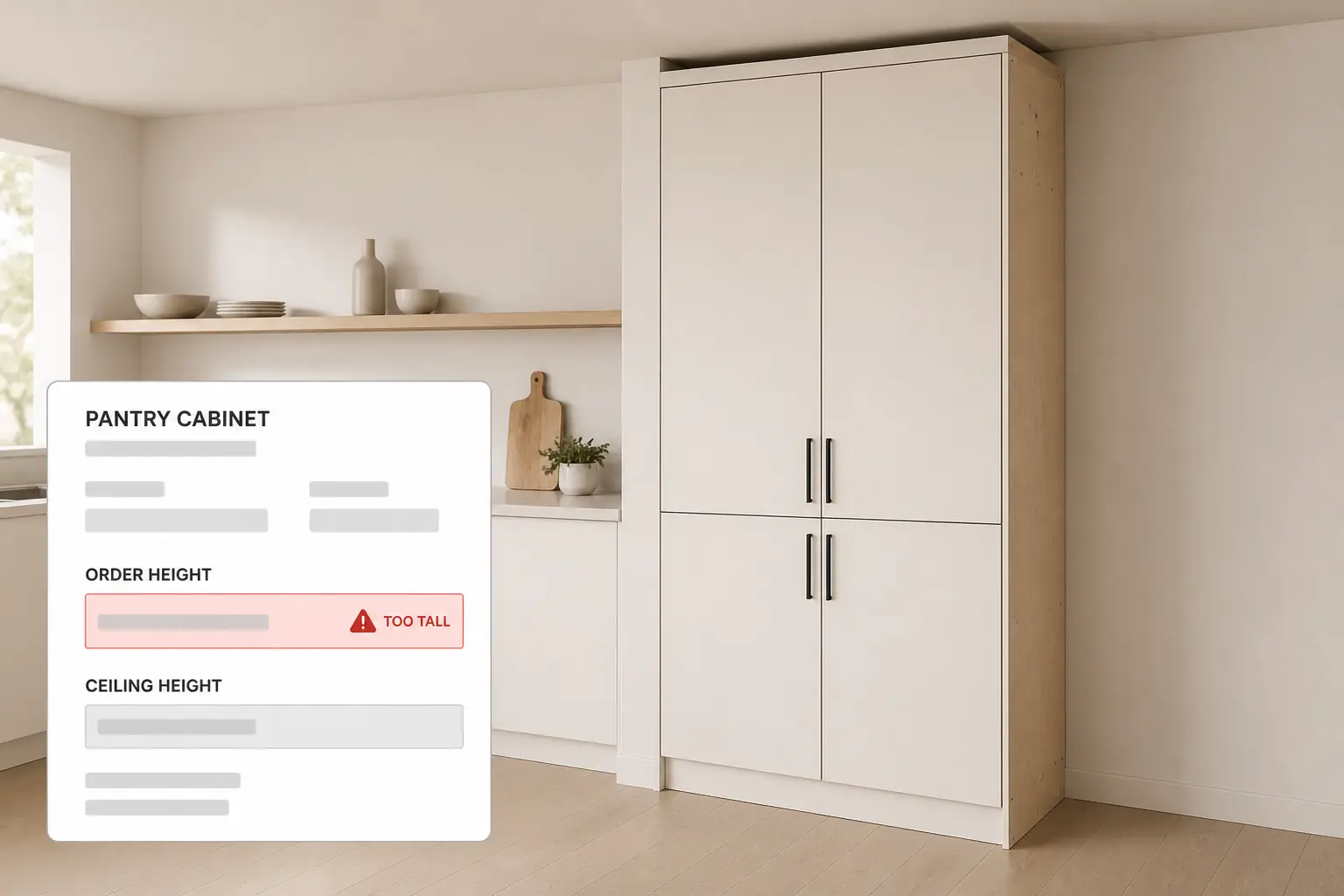
A configured full height pantry cabinet standing taller than the finished ceiling beside it, the order entry mistake this guide to reducing manufacturing errors opens on

Start with one incident. On r/cabinetry, a 248 comment thread picked over a tall pantry that did not fit. Nobody confirmed the ceiling height. An 8 foot pantry was ordered into an 8 foot room, and the installer cut the toe kick to force it. The thread never blamed the factory. It asked who owned the measurement, because that answer decides who pays for the new cabinet. Prevention budgets point at the shop floor. This error never went near it.

Key takeaways

  1. The most expensive manufacturing errors are decided before anything is cut: in the quote, the spec, and the sales to production handoff. The factory builds exactly what was ordered.

  2. 48% of US construction rework traced to poor data and miscommunication, $31.3 billion in 2018 alone, in a commissioned FMI study. FMI and Autodesk, 2018

  3. Field audits found errors in 88% of spreadsheets, and most made to order shops still quote in one. Panko, University of Hawaii, 2008

  4. The money is material: quality costs run 15 to 20% of sales revenue for many organizations, up to 40% of total operations. ASQ

  5. Across 16 live Reddit threads, the control practitioners agree on is a review of the spec before release. The durable version of that review is a system that refuses invalid orders at entry.

The definition

What counts as a manufacturing error, and the half this guide covers

A manufacturing error is any deviation between what the customer needed and what was built. It can enter at any step from the quote to the install, not only on the factory floor. The legal taxonomy splits defects in two. A manufacturing defect departs from its own spec. A design defect is a spec that was wrong to begin with. Operations people live with a third kind the taxonomy hides, the order that was entered cleanly and was still wrong.

The stakes are not rounding error. Quality costs run 15 to 20% of sales revenue for many organizations, and as high as 40% of total operations (ASQ, Cost of Quality). Yet in ASQE's 2025 Insights on Excellence survey, only 31% of organizations said they fully understand what quality costs do to their financial performance (ASQE, 2025).

One honest split before the argument starts. Production errors, the ones made during the build, are real, and the quality system that catches them is mature: process validation, first article inspection, statistical control. A post mortem on r/manufacturing about strap hardware that slipped in the first production run settled exactly there. The brand had approved production from prototype parts and skipped validation on off tool parts. No order form prevents that failure. This guide covers the other half, the errors decided before production starts. That half is larger than most prevention budgets assume, and almost nobody writes about it.

The evidence

The expensive errors are decided before production starts

Roughly half of rework traces to bad data and handoffs, not to execution. In FMI's commissioned study for Autodesk and PlanGrid, 48% of US construction rework traced to poor project data and miscommunication, an estimated $31.3 billion in 2018 (FMI, Construction Disconnected, 2018). The follow-up global study put $88.69 billion of 2020 rework down to bad data alone (Autodesk and FMI, 2021). And the recorded figures run low. A study of completed projects in the Journal of Construction Engineering and Management found actual rework costs underreported by 300% (Love, via ASCE, January 2026).

Where construction rework comes from, the share of manufacturing errors decided in the data before productionBar chart of the FMI and Autodesk 2018 commissioned study of US construction rework. 48% of rework traced to poor project data and miscommunication, 52% to all other causes. The poor data share cost an estimated 31.3 billion dollars in 2018.Poor data and miscommunication48%All other causes52%Source: FMI for Autodesk and PlanGrid, Construction Disconnected, 2018
The rework split in FMI's 2018 commissioned study of US construction. The green share was decided before anyone built anything: bad data and miscommunication, worth an estimated $31.3 billion in that year alone.

The numbers are construction's, but the shape repeats in every made to order trade. In one 90 day window, four communities told the same story. An RFQ arrived without an editable CAD file. A scope was approved and could not be built. A pantry was ordered on an unconfirmed ceiling height. A print called out one depth three ways. Different trades, same door: the error entered with the information, before production, and the build then executed it faithfully.

Door one

Error door one: the quote

Most made to order shops quote by hand, and hand work carries a known error rate. Asked how they quote today, machinists in a recent r/Machinists thread answered paper prints and a catalogue markup, Excel and a guess, or a phone invoice app. The input is no better. Shops that quote daily say the RFQ arrives as a screenshot, a photo, or an STL with no editable CAD. The quote then starts on documented assumptions after a day lost asking.

The error rate of that hand work is measured. Mechanical keying errs on about 0.5% of entries and cognitive work on 1 to 5% of tasks (Panko, University of Hawaii, 2008). Those rates are too small to feel and too large to survive compounding. Which is why field audits found at least one error in 88% of audited spreadsheets (Panko's 2008 audit summary). A quote built in one inherits its mistakes with a signature line underneath.

Human error rates by task type, why manual quoting compounds small slips into production errorsBar chart of base human error rates from Raymond Panko's research at the University of Hawaii. Mechanical keying errs on about 0.5% of entries and cognitive work on 1 to 5% of tasks, yet field audits found at least one error in 88% of audited spreadsheets, because hundreds of small per-cell rates compound into per-document failure.Keying, per entry0.5%Cognitive work, per task1 to 5%Spreadsheets with at least one error88%Source: Raymond Panko, University of Hawaii, spreadsheet audit research, 2008
Panko's base rates beside his audit result. No single entry is risky, and almost every finished spreadsheet is: a quote with a few hundred hand-entered cells carries the compound of every one of them.

The shops that reduce quoting errors do it by fixing the input, not the person. Demand the editable file, write the assumptions into the quote, and take the arithmetic away from the keyboard. That last move is its own subject. Our guide to quote automation covers it for configured products.

Door two

Error door two: the spec and order entry

An order can be entered correctly and still be wrong, because nothing checked it against reality. The pantry ordered into a room with an unconfirmed ceiling height is one of four cabinet incidents in the same 90 days. A finished end panel was ordered on the wrong side. A 1 inch overlay was ordered with a half inch hinge. And two cabinets share a stile, so a designer's identical 20 inch spec builds two different boxes. The rule lives only in the shop's head. Every one of those parts was made correctly to an order that could not produce what the buyer wanted. Every buyer read the result as a manufacturing defect.

Order entry has a measured failure rate too. On APQC's perfect order index, an ongoing benchmark, median performers fail on roughly 10% of orders (APQC, via Supply and Demand Chain Executive). The top quartile scores 95 or better on the same index. One order in ten arriving wrong, late, or incomplete is the median, not the horror story. For option-built products, the constraints a cabinet configurator carries are exactly the ones the pantry order needed. A ceiling height field refuses a cabinet taller than the room. A machine builder meets the same failure at a higher price, which is what equipment manufacturing CPQ exists to stop.

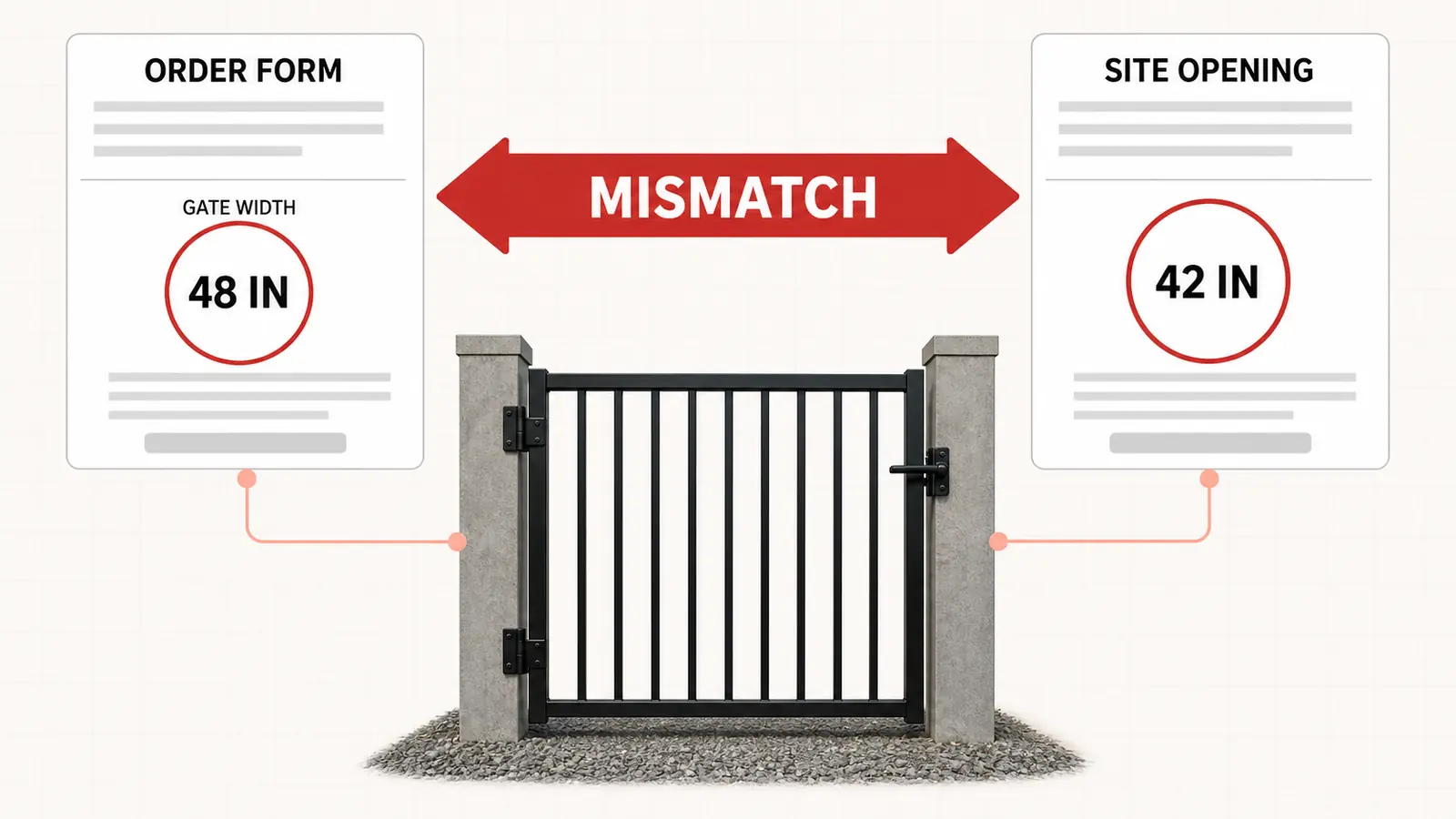
An order form's gate width beside the measured fence opening it does not match, the spec to order mismatch that becomes a manufacturing error
Door three

Error door three: the sales to production handoff

When quoting and production run on disconnected systems, the system itself allows a sale that cannot be built. In an escalation on r/sales, a seller got an edge case approved while the senior engineer was away. The seller quoted it, and learned weeks later it could not be delivered. The top reply describes quoting something physically impossible because the internal documentation was wrong and nothing blocked it. The recovery advice splits in two, clean up the deal, then fix the handoff that let the bad quote leave.

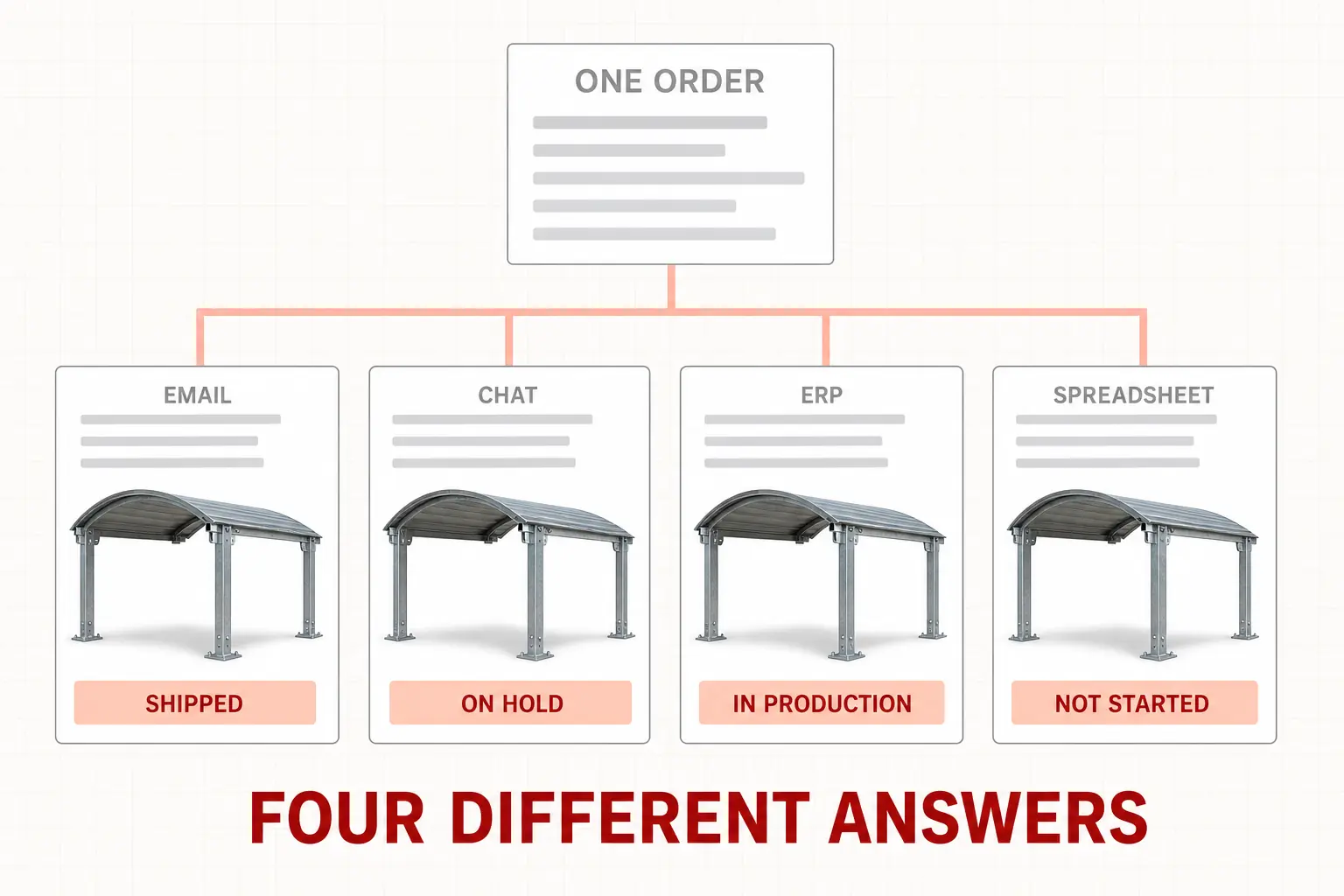
The quieter version is order status living in five places that disagree. An engineer to order manufacturer describes program status spread across email, Teams, the ERP, and a graveyard of spreadsheets. Answering which jobs are at risk means guessing which source lies least. The shop hired a program manager who became the integration, and the chaos returned when he left, because the knowledge lived in his head. Poor data quality of this kind costs organizations an average of $12.9 million a year (Gartner, 2020). No one line of it appears on a scrap report.

One carport order shown in four disconnected systems, email, chat, ERP, and a spreadsheet, each reporting a different status, the handoff gap where manufacturing errors enter
The controls

How to reduce manufacturing errors: seven controls that work

Ask practitioners how to reduce errors and increase quality of work, and the answers share one shape. Every control is a check of the input before release, not an inspection after the fact. These seven are how working shops reduce errors today. Each comes from a live thread, not a brochure.

The seven controls that reduce manufacturing errors before production: what each one stops and where the check runs
ControlWhat it stopsWhere the check runs
Require the editable fileA quote built on a screenshot and a guessThe RFQ form, before the clock starts
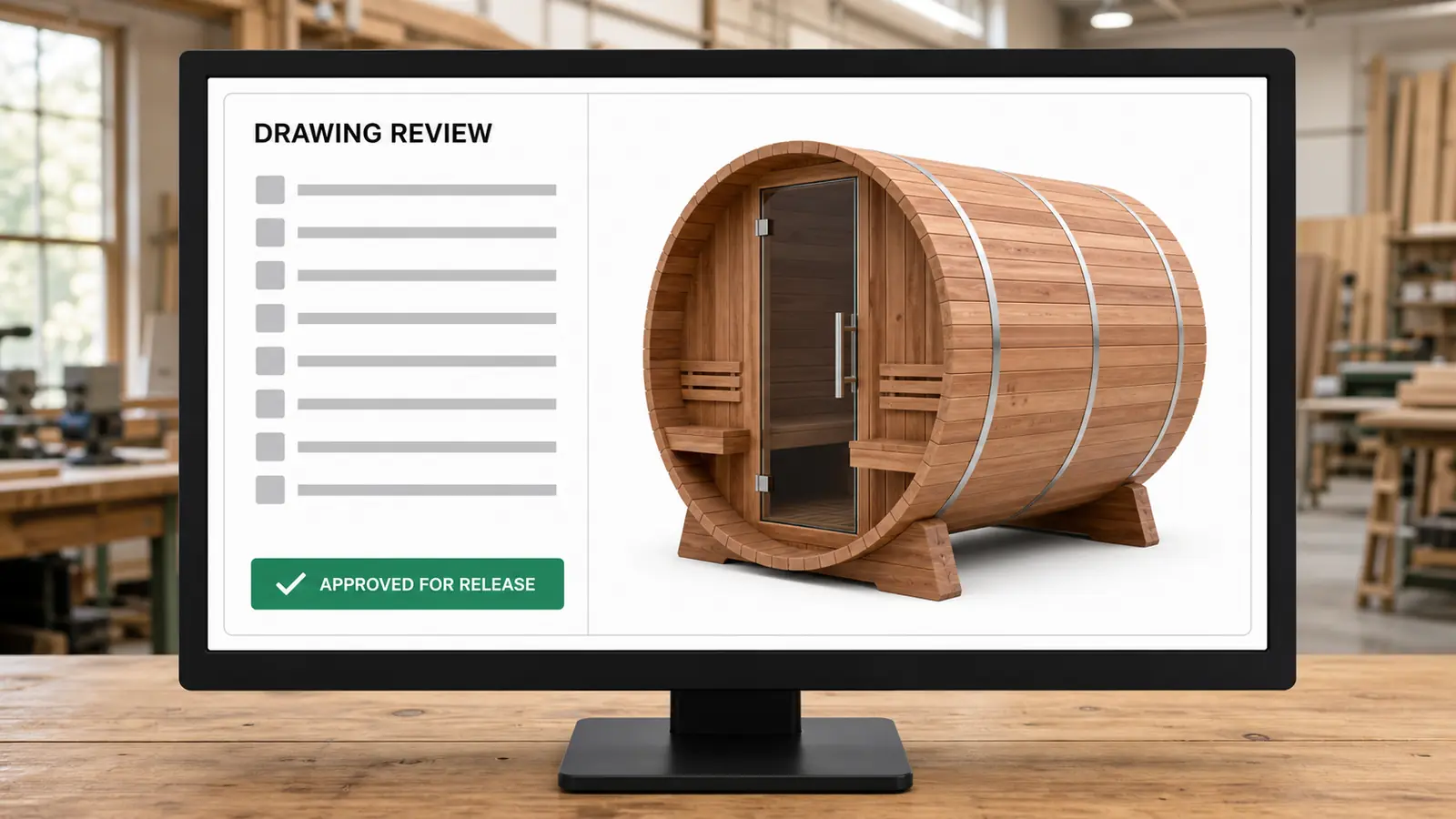
A human approves the drawingAn ambiguous print reaching the machineDrawing review, before release
Redraw the order in your own systemThe designer's numbers becoming the build's numbersShop drawings, approved before cutting
Put the numeric spec on the purchase orderA vendor changing what the order did not pin downThe purchase order
Force scope to a recorded callAn approved scope that cannot be builtThe statement of work, before the quote leaves
Prototype cheapDrawing ambiguity found in a billetA 3D printed sample of every new part
Encode the rules at entryAn invalid build entered by a careful person on a bad dayThe order entry system, on every order

The seven in detail, each with the thread it comes from.

  1. Require the editable file before quoting. State the formats you accept on the RFQ form itself, so the chase for a STEP file happens before the clock starts.
  2. A human approves the drawing before release. The top comment on the ambiguous print thread, at 48 points, is one line. A person checks and approves every drawing before it reaches production.
  3. Redraw the order in your own system. Cabinet shops re-enter the designer's drawing in their own software and submit shop drawings for approval before cutting. The designer's numbers are not the build's numbers.
  4. Put the numeric spec on the purchase order. A process description is not a spec. The strap adjuster post mortem settled that a vendor is free to change whatever the purchase order does not pin down.
  5. Force scope to a recorded call. Then write the statement of work yourself, so the paper trail exists before the quote leaves, not after the dispute starts.
  6. Prototype cheap. One shop 3D prints a plastic sample of every new part. Drawing ambiguity becomes visible while it costs grams of filament instead of a billet.
  7. Encode the rules, so the system refuses an invalid build at entry. The six controls above depend on a person being present and careful. The seventh does not, and the next section is about it.
A drawing review screen on a workshop monitor showing a barrel sauna approved for release, the input check that reduces manufacturing errors before production

Notice what is missing: nobody's answer is inspect harder. Eliminating errors after they enter is the expensive version. Refusing them at entry is the cheap one. The downtime numbers agree that blame is not a control. In the 2017 Vanson Bourne study for ServiceMax, human error causes 23% of unplanned manufacturing downtime (via Engineering.com). The same study puts other sectors as low as 9%. People err at a stable rate. Systems decide whether the error becomes a build.

The system

What a product configurator changes, and what it cannot

A configurator moves the spec check from a person to the point of entry, so control seven stops depending on who is in the office that day. The rules that live in the shop's head are encoded once and enforced on every order. Which hinge fits which overlay, how a shared stile changes a door width, what the ceiling height allows. The hinge that cannot match its overlay is never offered, so the order that paired a 1 inch overlay with a half inch hinge is never placed. That is what CPQ for manufacturers does with the error doors: it closes them at the entry.

The case is strongest where nobody on the SERP looks: the dealer channel. When dealers order on the customer's behalf, the person entering the spec is not the person who knows the trade's rules. So the constraint has to live in the tool, not in anyone's memory. A dealer ordering platform exists for exactly that seat, and what a configurator changes for a dealer network is the same thesis argued from the dealer's side.

And the honest close: none of this fixes the shop floor half. A validated process, first article inspection, and the discipline the strap adjuster thread demanded are still the controls for the errors made during the build. What constraint at entry removes is the other half of the cost of quality ladder charted below, the half that was never a manufacturing problem to begin with. The ladder's widest rung is Juran's: cost of poor quality at about 15% of sales, ranging from 5 to 35% with product complexity (Juran, Quality Control Handbook).

The cost of quality ladder, what unchecked manufacturing errors cost as a share of sales and operationsRange chart of published cost of quality figures, each with its own source and unit. Juran's Quality Control Handbook puts cost of poor quality at 5 to 35% of sales depending on product complexity. ASQ's rule of thumb for a thriving company is 10 to 15% of operations, many organizations run 15 to 20% of sales revenue, and ASQ's upper bound reaches 40% of total operations, marked as a ceiling on the axis.Juran, % of sales, by complexity5 to 35%ASQ, thriving company, % of operations10 to 15%ASQ, many organizations, % of sales15 to 20%010203040ASQ ceiling: 40% of operationsSources: ASQ, Cost of Quality; Juran, Quality Control Handbook
The published cost of quality ranges, attributed one by one because their units differ. Whichever rung a shop sits on, the spend is a material share of the business, and most of it is failure cost rather than prevention.
FAQ

Common questions about manufacturing errors

Short answers to the questions people actually search. The first sentence of each is the answer.

Bad inputs and broken handoffs cause roughly half of them: 48% of US construction rework traced to poor data and miscommunication in FMI's 2018 commissioned study. Human execution error is the smaller share, causing 23% of unplanned manufacturing downtime in the 2017 Vanson Bourne research. The useful split is errors decided before production, in the quote, the spec, and order entry, versus errors made during the build.

A manufacturing defect is a unit that departs from its own specification: the design was right and the build was wrong. A design defect is a product built exactly to a specification that was itself wrong. Operations teams need a third category the legal taxonomy hides: the order entry error. The factory builds exactly what was ordered, and the order did not match the customer's reality.

Change the system before blaming the person. Base human error rates are stable in Panko's University of Hawaii research (2008), about 0.5% per keying entry and 1 to 5% for cognitive work. A process that depends on flawless hand work fails on schedule. On the floor that means error proofing, the poka-yoke fixtures and checks that make a mistake hard to commit. Before the floor it means validating the spec at entry, so an invalid order is refused instead of discovered.

ASQ puts quality costs at 15 to 20% of sales revenue for many organizations, and as high as 40% of total operations. Juran's Quality Control Handbook gives about 15% of sales, ranging from 5 to 35% with product complexity. The recorded numbers run low: a January 2026 study in the Journal of Construction Engineering and Management found actual rework costs underreported by 300%.

Last updated

The pattern runs through every incident in this guide. Manufacturing errors enter at the input, the control is a check before release, and whoever owned the measurement owns the replacement. So own the measurement with a system. See how CPQ for manufacturers encodes your rules so an invalid order is refused at entry. Or book a demo and bring the order that burned you last.

Last updated

Portrait of Teodoro Pickett

Teodoro Pickett

Teodoro Pickett runs marketing at Dealect and writes the blog, covering CPQ, product configurators, and the business of selling custom products through dealer networks. He came to it after seven years of marketing and search for B2B software companies. Every article is written for manufacturers first, checked against sources a reader can open, and updated as the category moves.

How we source and correct sets out where our facts come from, how our own product appears in our own comparisons, and how to tell us we got something wrong.

Keep reading

Where to go next

The blog

Latest articles

All articles
  • A configured cedar pergola with one floating card reading quote, valid 30 days, the price quote this guide defines
    Quotes, defined

    What is a price quote? Definition, parts, and when it binds

    A price quote is a formal offer to sell at a fixed price for a set time. What it must include, how it differs from an estimate, a sales order and an invoice, when it binds, and how to send one the same day when the price depends on the configuration.

    12 min read
  • A cedar barrel sauna beside four research findings on how B2B buyers prefer to configure and validate a custom product quote.
    Statistics, sourced

    Custom product quoting statistics for 2026

    Fourteen sourced numbers on how B2B buyers buy custom products, what self-service quoting does to deal quality, and four popular figures that have no source.

    9 min read
Bring the order that burned you

Watch an invalid order get refused.

Request a 30-minute call, bring one product and the order entry error that cost you a rebuild, and see the rule that would have refused it. We reply by email to set up the time.

  • 30-minute personalized demo
  • See real configurators in your industry

Your call is with the Dealect team.