Blog · Statistics, sourced

Custom product quoting statistics Fourteen sourced numbers

Most quoting statistics on the web carry no source. These fourteen do. Each number below links to the research that produced it, states the year it was measured, and gives the sample when the publisher states one.

Teodoro PickettBy Teodoro Pickett·Last updated 9 min read
A cedar barrel sauna beside four research findings on how B2B buyers prefer to configure and validate a custom product quote.

A manufacturer who sells configured products is asked the same question by every software vendor: how much faster would your quotes be? The answer usually arrives as a percentage with no study behind it. This page is the opposite. It collects the numbers that are actually published, names who measured them and when, and says plainly which popular figures we will not repeat.

Key takeaways

  • Two thirds of B2B buyers now say they would rather buy without a sales rep, and that share is still rising.
  • Buying with no help is not the same as buying well. Buyers who go alone report far more regret, and deals get better when a tool and a person work together.
  • The self-service shift is a channel question for manufacturers, not only a website question. The dealer is the person the tool has to serve.
  • Four widely quoted quoting statistics have no traceable source. They are listed here so you can stop repeating them.
The rule

How to read these numbers

Three rules govern this page. A number appears only when we can open the research that produced it. Every number is attached to the year it was measured, because a 2021 forecast and a 2026 survey are not the same evidence. And a number stays out when the only trace of it is another vendor page quoting a third vendor page.

That last rule removes most of what circulates about quoting. It also explains why this page is shorter than the statistics roundups you have read elsewhere.

One more limit is worth stating. None of the research below studies custom manufacturers specifically. It studies B2B buying, manufacturing operations, and software markets. We say what each source measured, and you decide how far it travels to your product line.

Four numbers

How B2B buyers want to buy now

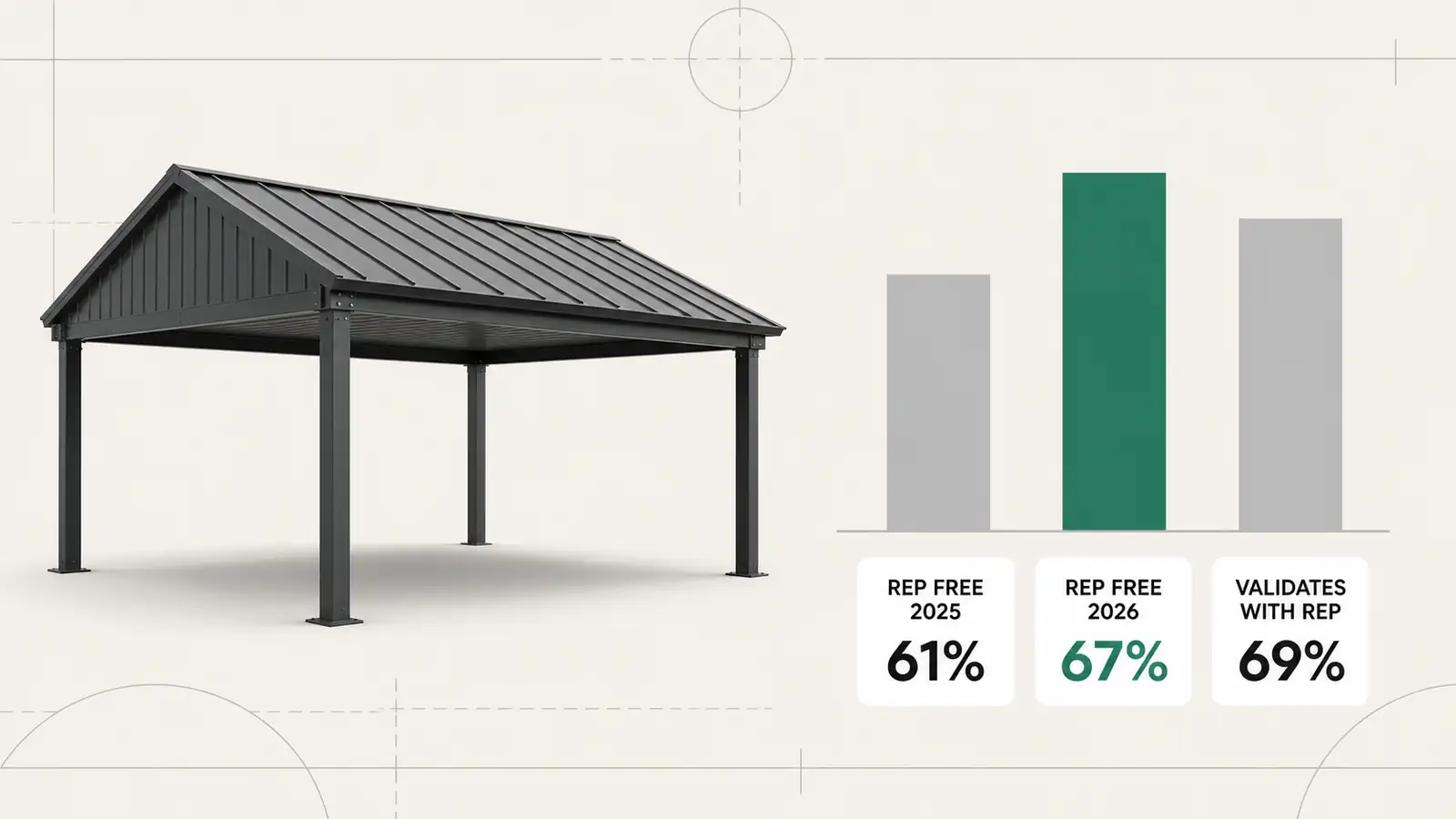
67% of B2B buyers prefer a rep-free experience. Gartner surveyed 646 buyers in August and September 2025 and published the finding in March 2026 Gartner, March 2026. For a manufacturer this is the whole argument for putting a configurator in front of the price conversation.

The same measure was 61% a year before. Gartner published that figure in June 2025 Gartner, June 2025. Six points in twelve months is the part that matters. The direction is steady, so a quoting process built around a phone call is getting further from the buyer every year.

45% of buyers used an AI tool during a recent purchase. From the same March 2026 Gartner survey Gartner, March 2026. Buyers now arrive with an answer they got somewhere else, and they arrive earlier.

69% of buyers still turn to a sales rep to check what the AI told them. Gartner published this in May 2026 Gartner, May 2026. Read the two together and the picture is clear: buyers want to do the work themselves, then have a person confirm it. That is exactly what a dealer does with a configured quote.

A configured steel carport beside two bars comparing the share of B2B buyers who preferred a rep-free experience in 2025 and 2026, and the share who still ask a rep to check an AI answer.
Rep-free preference is rising, and so is the need for a person to confirm the answer. Both figures are Gartner survey results, 2025 and 2026.
Three numbers

What happens when buyers quote alone

This is the section most self-service statistics leave out, and it is the one that should shape what a manufacturer builds.

43% of buyers who complete a digital self-service purchase report high purchase regret. The figure is a chart in the Gartner B2B Buying Report, measured in a 2022 Gartner survey of 441 buyers who completed a purchase Gartner B2B Buying Report, 2022. An earlier Gartner release adds that purchase regret runs 23% higher for buyers who preferred no rep contact at all Gartner, May 2021. A regretted order on a custom product is not a return. It is a build that is already cut.

Buyers are 1.8 times more likely to complete a high quality deal when they use supplier digital tools together with a rep rather than independently. Gartner, March 2026 Gartner, March 2026. This is the number that decides the shape of a manufacturer's configurator. The goal is not to remove the seller. It is to put the same tool in the seller's hands and the buyer's.

74% of B2B buying teams show unhealthy conflict during the decision process. Gartner published this in May 2025 Gartner, May 2025. Custom products make this worse, because the buying team is arguing about a specification that does not exist yet. A shared, visual, priced configuration is the artifact that ends the argument.

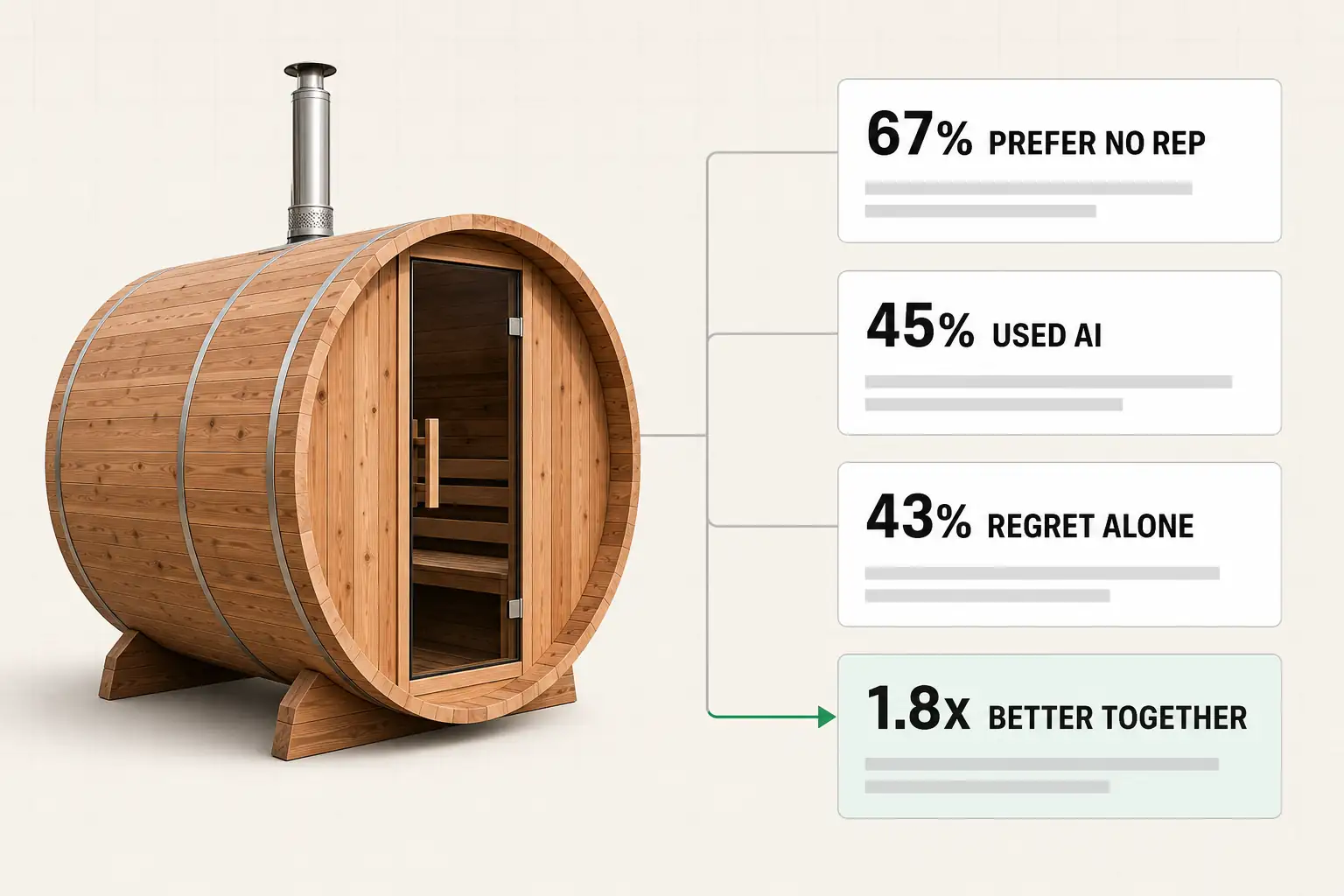
Buyers want to configure without being sold to, then want a person to confirm the result. A configurator that only serves one of those two jobs solves half the problem.

For manufacturers who sell through a channel, the person doing the confirming is usually the dealer. That is the subject of what a configurator changes for a dealer network.

Two numbers

Where the money moved

US B2B ecommerce was USD 1.7 trillion in 2021 and is forecast above USD 3 trillion by 2027. Forrester published the forecast in June 2022, with a five year compound annual growth rate of 10.7% Forrester, June 2022. Forrester counts sales by manufacturers direct to businesses and by wholesalers and distributors indirectly, so the dealer channel is inside this number, not outside it.

24% of all US B2B sales are forecast to run through ecommerce by 2027, against 17% of transactions in 2022, from the same forecast Forrester, June 2022. Treat it as a direction, not a promise. It is a four year old forecast, and we mark it as one.

A caution that belongs here. Neither figure says a configured, engineered product sells the way a catalog part sells. A pergola with eleven option groups does not become a cart item because the category grew. What the growth does say is that the buyer expects to start online, and the quote is where that start either continues or stops.

Four numbers

What the factory is carrying

80% of manufacturers plan to put at least 20% of their improvement budgets into smart manufacturing. Deloitte surveyed 600 manufacturing executives in 2025 and cites the result in its 2026 outlook Deloitte, 2026 Manufacturing Industry Outlook. Most of that budget goes to the plant. Very little of it reaches the quote.

More than 81% of manufacturing task hours are expected to stay human driven. Also from the Deloitte outlook Deloitte, 2026. Useful context for anyone told that quoting is about to run itself.

74.2% of US manufacturers reported a positive company outlook in the second quarter of 2026. The National Association of Manufacturers fielded the survey from 12 to 28 May 2026 NAM, Q2 2026. That is in line with the historical average of 74.3%.

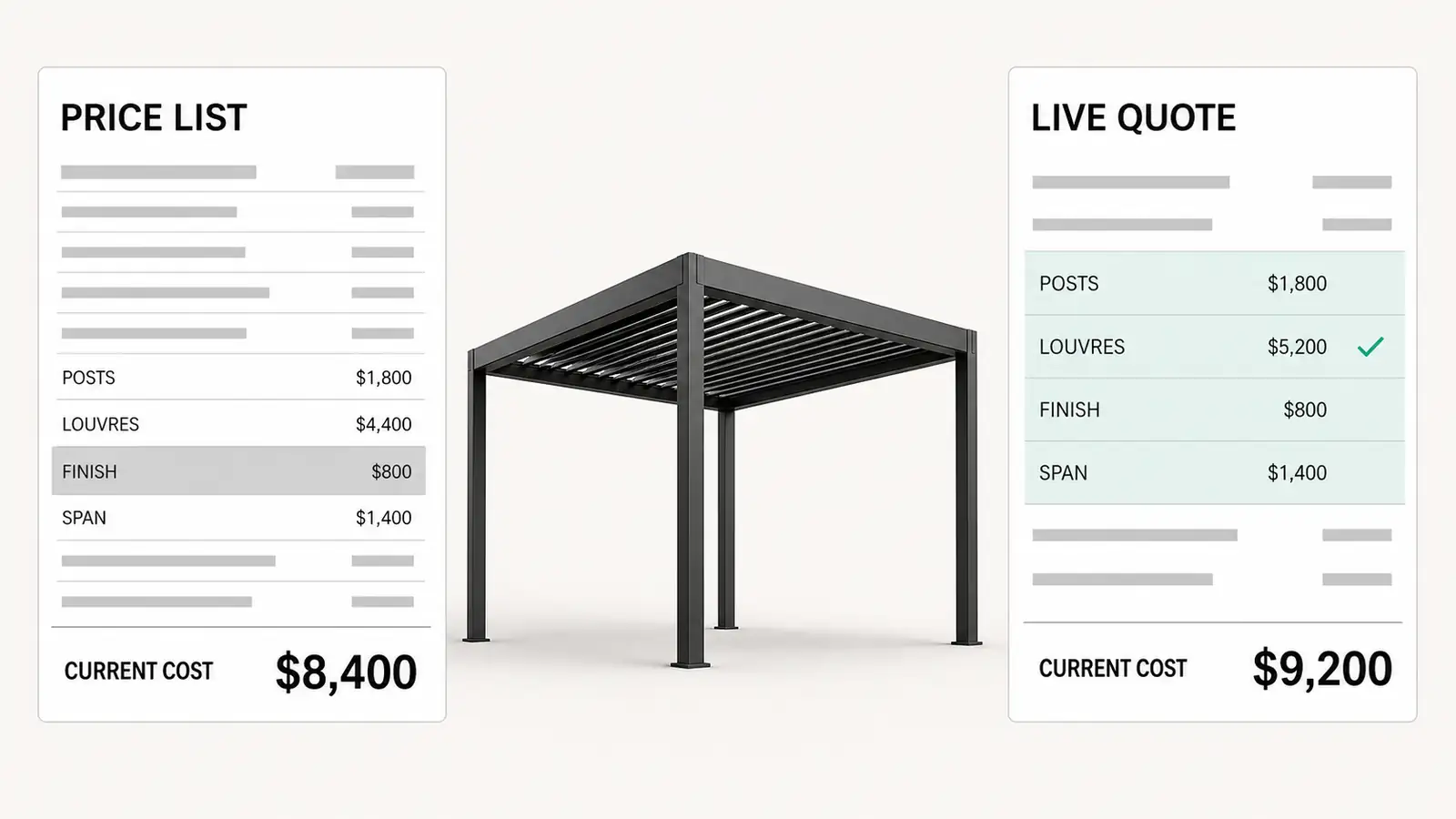
83.1% named rising raw material costs a top challenge, up 25.6 points in one quarter. From the same NAM survey NAM, Q2 2026. This is the quoting number hiding inside an economics survey. When material cost moves that fast, a price list in a spreadsheet is wrong before the dealer opens it, and quote automation stops being a convenience.

A dealer price list in a spreadsheet beside the same options priced from a live rule set, showing where a stale material cost changes the quote total.
Where a material cost increase reaches the dealer quote. Illustrative product and prices, not a customer quote.
One number

The quoting software market

One term first. CPQ is short for configure, price, quote. It is the software that turns a product's options and rules into a valid, priced quote. Ours is built as CPQ for manufacturers who sell through dealers. The document at the end of that flow, and what a price quote is in the first place, has its own guide.

The configure, price, quote software market was valued at USD 3.46 billion in 2025 and is forecast to reach USD 10.89 billion by 2033. That is a compound annual growth rate of 15.6% from 2026 to 2033, from the 2026 edition of the report Grand View Research, 2026.

Read a market forecast for what it is. It is a commercial research estimate, not a survey, and different firms put the same market between 15% and 17% annual growth. The useful part is the agreement on direction, not the decimal. If you want the category explained rather than sized, start with what CPQ is.

The other list

Four numbers we refuse to repeat

These four appear on vendor pages constantly, including on pages that sell what we sell. Each one fails at least one of the three rules above.

“A configurator cuts quoting errors by 90%”

No published study supports it. The figure moves between vendor pages with no sample, no year, and no method. We have never found the original. Until someone produces it, it is marketing copy wearing a percent sign.

“Quotes go out 10 times faster”

Same problem, and a worse one. Even where a real customer saw that change, the starting point decides the multiple. A shop that quoted in six days and now quotes in six hours is a true story and a useless benchmark for a shop that already quotes in a day.

“Sales reps spend only 30% of their time selling”

A real number exists somewhere underneath this one, but it is quoted with a different year, a different denominator, and a different definition of selling almost every time it appears. We would rather cite nothing than cite a figure we cannot pin to one published table.

“Answer within an hour and you are 7 times more likely to qualify the lead”

This one is real, and it is still not usable here. It comes from a Harvard Business Review study of online lead response published in March 2011 Harvard Business Review, March 2011. It measured web form leads fifteen years ago, not custom product quotes. Speed clearly matters. That study is not the proof for this market.

A statistic with no source is not evidence. It is a claim that found a costume.
The whole set

All fourteen numbers, in one table

Cite any row. Each links to the publisher, and the year column is the year the data was measured or published, not the year we found it.

Fourteen sourced statistics about B2B buying, custom manufacturing, and quoting software, each with what it measures and the publisher and year behind it.
NumberWhat it measuresSource and year
67%B2B buyers who prefer a rep-free experienceGartner, 2026
61%The same measure one year earlierGartner, 2025
45%Buyers who used an AI tool during a purchaseGartner, 2026
69%Buyers who ask a rep to validate an AI answerGartner, 2026
1.8xHigher chance of a high quality deal when a digital tool and a rep work togetherGartner, 2026
43%Buyers reporting high regret after a digital self-service purchaseGartner, 2022
74%B2B buying teams showing unhealthy conflict while decidingGartner, 2025
USD 1.7TUS B2B ecommerce sales in 2021Forrester, 2022
24%Forecast ecommerce share of all US B2B sales by 2027Forrester, 2022
80%Manufacturers putting 20% or more of improvement budgets into smart manufacturingDeloitte, 2025
81%+Manufacturing task hours expected to stay human drivenDeloitte, 2025
74.2%US manufacturers with a positive company outlook in Q2 2026NAM, 2026
83.1%US manufacturers naming raw material costs a top challengeNAM, 2026
USD 3.46BCPQ software market value in 2025Grand View Research, 2026

Reusing a row is welcome. Please carry the publisher and the year with it, and link the source rather than this page. That is the whole point of collecting them this way.

FAQ

Quoting statistics questions, answered.

Five direct answers on the headline figures, what they mean for a configured product, and what we left out.

67% of B2B buyers said they prefer a rep-free experience in a Gartner survey of 646 buyers run in August and September 2025 and published in March 2026. The same measure was 61% one year earlier.

Not on its own. In the Gartner B2B Buying Report, built on a 2022 survey, 43% of buyers who completed a digital self-service purchase reported high purchase regret. Gartner also finds buyers are 1.8 times more likely to complete a high quality deal when they use a supplier's digital tools together with a rep rather than alone.

Grand View Research valued the configure, price, quote software market at USD 3.46 billion in 2025 and forecasts USD 10.89 billion by 2033, a compound annual growth rate of 15.6% from 2026 to 2033.

Because no published study supports that figure. It circulates between vendor pages without a source, a sample, or a year. This page carries only numbers with a link to the research behind them.

Every number is rechecked against its source when the source publishes new data. The date at the top of the page is the last time the set changed, and each row in the summary table states the year its number was measured.

Last updated

The short version

What the fourteen numbers add up to

  • Buyers want to configure alone. Two thirds prefer no rep, and the share grows each year.
  • Alone is where deals go wrong. Regret is high without help, and deals are 1.8 times better when the tool and the person work together.
  • So the tool belongs in both hands. For a manufacturer selling through a channel, that means the dealer quotes with the same rules the buyer configures with.
  • And the price has to be live. When material cost jumps 25 points in a quarter, a spreadsheet price list quotes yesterday.

If one of your product lines is quoted by dealers today, the practical next step is to follow one real option set from the buyer's choice to the priced quote and see where the numbers above start to apply.

Last updated

Portrait of Teodoro Pickett

Teodoro Pickett

Teodoro Pickett runs marketing at Dealect and writes the blog, covering CPQ, product configurators, and the business of selling custom products through dealer networks. He came to it after seven years of marketing and search for B2B software companies. Every article is written for manufacturers first, checked against sources a reader can open, and updated as the category moves.

How we source and correct sets out where our facts come from, how our own product appears in our own comparisons, and how to tell us we got something wrong.

Keep reading

Where to go next

The blog

Latest articles

All articles
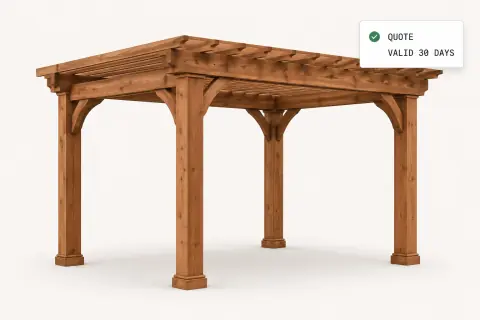
  • A configured cedar pergola with one floating card reading quote, valid 30 days, the price quote this guide defines
    Quotes, defined

    What is a price quote? Definition, parts, and when it binds

    A price quote is a formal offer to sell at a fixed price for a set time. What it must include, how it differs from an estimate, a sales order and an invoice, when it binds, and how to send one the same day when the price depends on the configuration.

    12 min read
Bring one product

See one option set become a buildable quote.

Request a 30-minute call and bring one product line. We will follow its choices, rules, price, and order output together.

  • 30-minute personalized demo
  • See real configurators in your industry

Your call is with the Dealect team.