Statistics, sourced
Custom product quoting statistics for 2026
Fourteen sourced numbers on how B2B buyers buy custom products, what self-service quoting does to deal quality, and four popular figures that have no source.
9 min read
A price quote is a formal document a seller sends a buyer that offers a specific product or job at a fixed price, itemised, valid for a stated period, and binding on the seller once the buyer accepts it. When the price depends on the configuration, price quoting is the slowest step between a buyer asking and a buyer signing.
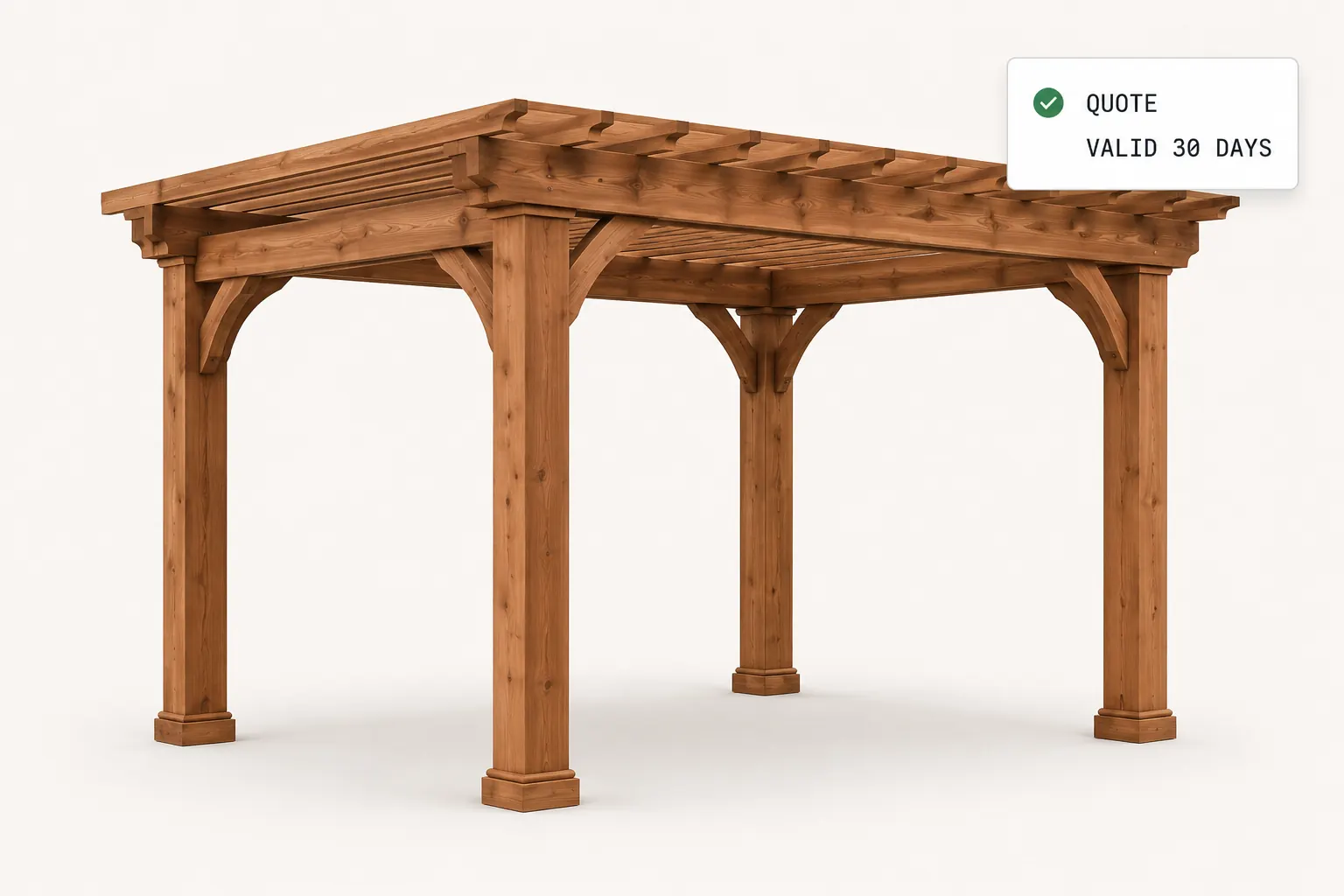
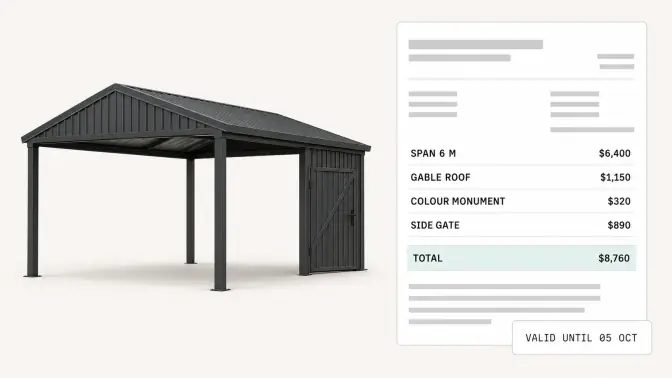
The customer asked for a price on Monday. The quote left on Thursday, because the one person who knows what a 6 by 9 metre carport with a side gate costs was on the shop floor. It was right. It was also late, and to a buyer late is wrong. Every guide to price quotes assumes a flat fee. Your pricing changes with every option, and the guides never say what that does to the document, to who signs it, or to how long it stays valid.
Key takeaways
A quote offers a specific product or job at a fixed price, valid for a stated period, and becomes a binding contract the moment the customer accepts it. Business Queensland
An estimate is a guess and binds nobody. Send one while the buyer is choosing, and a quote the moment the configuration is fixed.
A quote must carry the line items, the scope and its exclusions, the delivery date, the validity window, the payment terms and a signature line.
For a configured product, the quote is only as fast as the person who knows the pricing, and only as safe as the person who checks the build.
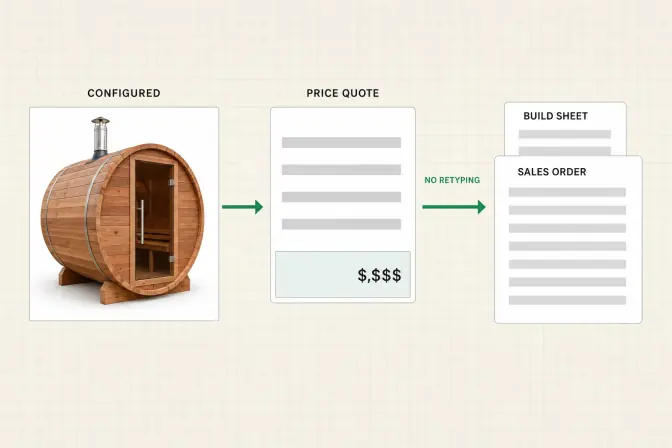
The quote's job ends when it turns into a sales order without anyone retyping it.
A price quote is a formal document that offers a specific product or job at a fixed price, itemised, valid until a stated date, and binding on the seller once the buyer accepts it. Four things make it a quote and not a guess. The price is fixed. The pricing is itemised. The validity is dated. And acceptance turns it into a contract. Take one away and you have an estimate, a proposal or a price list, and none of those can be signed.
The seller sends it: the manufacturer, or the dealer who sells the manufacturer's product on their own margin. The buyer reads it for three answers: what am I getting, what does it cost, and until when. So the meaning of a price quote is the promise, not the number. Configured products have a name for the whole path from options to pricing to document, and our guide to what CPQ is covers that path.
A manufacturer quotes because the buyer cannot read the price off a shelf. Every configured product is a new price, and it does not exist until someone works the options through the pricing. The quote is the only place the buyer sees it. Meanwhile the buyer asked three suppliers, and the first quote in sets the frame the other two are read against. In a Harvard Business Review audit of 2,241 US companies (HBR, 2011), firms that contacted a web lead within one hour were nearly 7 times more likely to qualify it than firms that waited even an hour more, and over 60 times more likely than firms that waited 24 hours or longer.
In Salesforce's State of Sales 2026 (4,050 sales professionals, fielded August to September 2025), the average seller spends 40% of their time selling. Price quoting by hand eats a large share of the rest. Fourteen more numbers on that sit in our custom product quoting statistics. The manufacturer whose pricing lives in one head sends the second quote, not the first.
Ten fields, and the ones a service firm can skip are the ones a manufacturer cannot. Government guidance lists the same core (business.gov.au, Prepare quotes). Here is the quotation breakdown in the order a buyer reads it.
Quote number and date. So the validity clock has a start.
Seller and buyer details. And who signs on each side.
The configuration as line items. Each option, its unit price, the total. This is the quote.
Scope of work and exclusions. What is in, and what is not: site work, permits, removal.
Delivery date and terms. When it ships, who installs it.
Validity window. The date the pricing stops holding. Thirty days is the common answer.
Payment terms and deposit. How much up front, when the balance is due.
Terms and conditions. Warranty, variations, what a change costs after acceptance.
Taxes and freight. Their own lines, never folded into the product price.
Signature or acceptance line. The line that turns the offer into a contract.
The manufacturer's quote carries three extra lines: the drawing the buyer approved, by number; the build sheet reference; and, when a dealer sends it, the dealer's pricing kept apart from the factory's. The cost side is the bill of materials, which is why procurement reads the same document as a cost breakdown and checks the line items first.
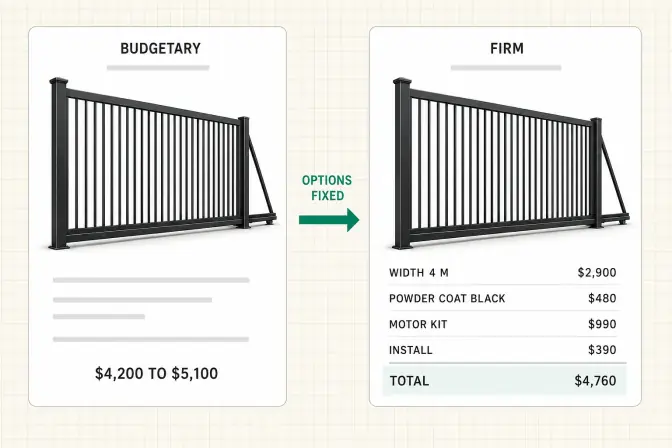
The type that matters to a manufacturer is budgetary against firm. The rest get one line each.
A budgetary quote is a planning number with no commitment and a wide tolerance. Send it while the buyer is choosing between a pergola and a carport. It never carries a signature line, because a buyer who signs a budgetary number will hold you to it.
A firm quote, the formal quote, is the price the seller will honour for the validity window. It has to be firm once the drawing is approved, because from then on the buyer is choosing between your number and a rival's.
A firm price that holds only if a named condition is met: a site inspection, a steel index. Write the condition on the quote, in one sentence.
An hourly rate plus materials, with no fixed total. Service work uses it. A configured product does not.
A configurator collapses the first two into one. A priced configuration is a firm number at budgetary speed: the buyer changes the span, watches the total move, and stops on a number you will build.
An estimate guesses, a quote promises, a sales order commits both sides, and an invoice collects. Every guide compares the first two. The row that matters to a manufacturer is the third.
| Document | When it is sent | Is the price fixed? | Binding? | What it becomes |
|---|---|---|---|---|
| Estimate | Before the details are known | No, a range or a guess | No | A quote, once the options are fixed |
| Price quote | Once the product and scope are defined | Yes, for the validity window | On the seller, once the buyer accepts | A sales order |
| Sales order | After the buyer accepts the quote | Yes | On both sides | A build sheet, then a shipment |
| Invoice | After delivery, or per the payment terms | Yes | A demand for payment on the buyer | A receipt |
The line between the first two rows is a legal one: if the customer proceeds, the quote forms part of a legally binding contract, and unlike quotes, estimates are not legally binding (Business Queensland, Preparing a business quote). So send an estimate while the buyer is choosing, a quote the moment the configuration is fixed, and never a quote you would not build at that price. On sales order vs quotation, the difference is who is bound. The price quotation binds the seller once accepted. The sales order binds both, which is why the shop works from it, and why the quote should become it without a retype.
One document, different owners. The sales team calls it a sales quotation, because it is what they send to close. The buyer's procurement desk calls it a cost quotation, because it is what they compare. A lawyer calls it a formal quote, because it is what binds.
Is it price quote or quotation? Both. Quote is the everyday form and wins in the United States. Quotation is the form in contracts, in procurement and on ERP screens, which is why the same document arrives as a price quotation in one system and a quote in the next. What a quotation in business is, when the word turns up in a contract, is this document. Quoting in business means sending it. The buyer's side has a name too: a request for quotation, or RFQ, asks for the price quotation before the seller writes it.
Seven steps, and step three is the one a service firm does not have. This is how to quote a price to a customer when the pricing depends on the configuration.
Confirm what they want, in their words and yours. Not "a shed". A 3 by 6 metre gable shed, zinc, a roller door on the short side. Write it back before you price it.
Check that the build is possible. The option rules. That roller door may not clear a 3 metre frame. Quotes the shop cannot build are the most expensive quotes you will send.
Price the configuration from the current pricing. Every option, the dealer's margin, the freight. This is the slow step, the one that waits for the person who knows the price list. Letting the rules do steps two and three is what quote automation means for a configured product.
Set the scope, the exclusions and the delivery date. A scope of work with no exclusions reads as "everything".
Set the validity window and the payment terms. Thirty days unless your material costs move faster. The deposit, the balance, and the late fee.
Get the sign-offs. The next section says who, and which a rule can make.
Send it, and put the follow-up date in the calendar as you send it. Same day if you can.
A template helps with steps four, five and seven. It cannot help with step three. Pricing a configuration is a decision, and a template only prints what someone decided.
Three people, three questions. Engineering asks "can we build this". Finance asks "do we make money on it". The sales lead asks "is that discount ours to give". Quote approval is the wait between a finished quote and a sent one, and a quote that waits for three people ships next week.
Two of the three checks can be made by a rule before a human looks. The build check is the option rules: if the configurator will not allow the roller door, engineering never has to look. The margin check is a floor: if the configured pricing sits above the floor margin, finance never has to look either. The discount still needs a person: a rep giving away more than their limit is a judgement, and a manager should make it.
Approval thresholds make that explicit. Below the rep's discount limit, no quote approval at all. Above it, one approver, with a deadline in hours. Above the manager's limit, two. The human check is not going away. Deloitte's 2026 manufacturing industry outlook (Deloitte, 2026) expects more than 81% of manufacturing task hours to stay human driven. Spend that hour on the discount.
A price quotation binds the seller once the buyer accepts it, in writing or by authorising the work, at that price, for that scope. Before acceptance it is an offer the seller can withdraw. That gap is why the validity window exists.
Yes, once accepted. Government guidance for contractors says it in one sentence: if a customer accepts your quote, it becomes a legally binding contract (business.gov.au). What binds is the price and the scope as written. A buyer who asks for a different colour after accepting has changed the configuration, and that is a new quote, not a discount argument. Say so in the terms and conditions.
Thirty days is the common answer; the field runs from seven to ninety. A configured product's window belongs at the short end, because its pricing is built from inputs that move. In the National Association of Manufacturers' Q2 2026 survey (NAM, fielded 12 to 28 May 2026), 83.1% of manufacturers named rising raw material costs a top challenge, up 25.6 points in one quarter. A ninety-day quote on a steel carport that quarter was a bet against steel.
Two lines handle it. State the expiration date, not a number of days. And where the pricing is indexed to steel or timber, say so. When a buyer accepts after the window, send a fresh quote at the current pricing.
Follow up in two to three business days, once, with a question about the configuration rather than the price. "Gate on the left or the right?" gets an answer. "Have you looked at the quote?" gets silence.
A manufacturer makes four quoting mistakes. Quoting an option combination that cannot be built. Quoting from last quarter's pricing. Leaving the validity window off. And sending quotes nobody approved.
Time from request to quote, in hours. Quote to order rate, the quote conversion figure stale pricing quietly lowers. And revisions per quote, because every revision was confirmed wrong at step one or priced wrong at step three. We publish no benchmark, because no independent study measures these for configured products. Measure your own for a month, then change one thing.
The quote's job ends when the buyer says yes and the same document becomes the sales order and the build sheet, with nobody retyping the options. Every guide stops at "send it and follow up". A manufacturer's quote has a second life on the shop floor, and every retype is where the wrong colour gets built.
A CPQ for manufacturers builds the quote from the configured product, so it leaves the same day instead of waiting on the one person who knows the price list. The configuration that priced the quote becomes the order, and the approved specification goes to the shop as the build sheet. That is what CPQ, short for configure, price, quote, is for. Often the sender is a dealer, quoting on their own margin from the manufacturer's current pricing without seeing its cost, and the order still has to reach the shop clean. That is the job of a dealer portal.
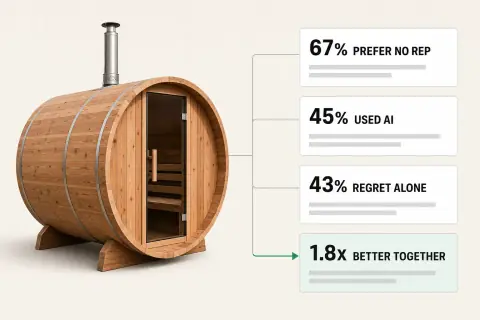
The buyer would rather not wait at all. In Gartner's survey of 646 B2B buyers (Gartner, fielded August to September 2025), 67% preferred a rep-free buying experience. The software category built for this handoff was valued at USD 3.46 billion in 2025 and is forecast at USD 10.89 billion by 2033 (Grand View Research, 2026).
The questions people ask next to this one, answered in the first sentence.
Sales quotation, cost quotation, formal quote, quotation, or simply quote. Same document, named by whoever is holding it. A budgetary quote is not another word for it; that one is a planning number with no commitment.
Both are correct and mean the same thing. Quote is the everyday form and the usual one in the United States. Quotation is the form in contracts, procurement documents and ERP screens. Pick one and keep it.
Send an estimate while the buyer is still choosing between products. Send a quote as soon as the configuration is fixed, because only a quote can be accepted and become an order. Never send a quote you would not build at that price.
Confirm the exact configuration, check that it can be built, price every option from the current list, set the scope, delivery date, validity window and payment terms, get the sign-offs, send it, and follow up in two to three business days.
Most manufacturers do not, because the quote is the sale. Charge when it needs engineering hours, such as a drawing or a site visit, and credit the fee against the order.
Last updated
A quote is a promise with a date on it. For a configured product the promise is only as good as the build check and the pricing behind it. And the quote is finished when it is an order nobody retyped. If your price quoting still ends on Thursday, the fix is not a better template. It is putting the options, the rules and the pricing in one place, which is what CPQ for manufacturers does, and what the call below shows on your own product.

Teodoro Pickett runs marketing at Dealect and writes the blog, covering CPQ, product configurators, and the business of selling custom products through dealer networks. He came to it after seven years of marketing and search for B2B software companies. Every article is written for manufacturers first, checked against sources a reader can open, and updated as the category moves.
How we source and correct sets out where our facts come from, how our own product appears in our own comparisons, and how to tell us we got something wrong.
Fourteen sourced numbers on how B2B buyers buy custom products, what self-service quoting does to deal quality, and four popular figures that have no source.
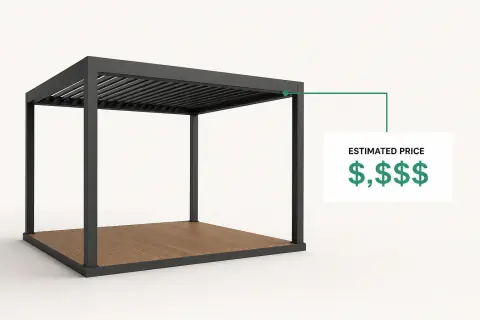
What live 3D product visuals do, how they differ from modeling and rendering, what they cost, and how a configured model becomes a valid dealer quote.
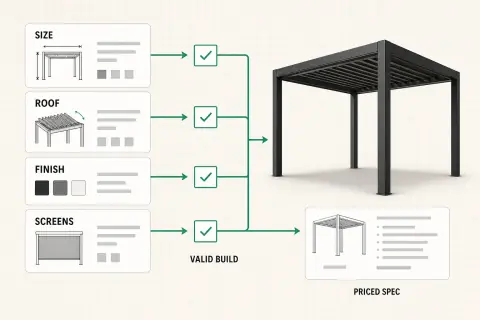
Product customization defined for manufacturers, with the four recognized types, industry examples, setup costs, and the path from buyer choice to quote and order.
Request a 30-minute call, bring one configured product, and see its options priced by rules and turned into a quote you could send. We reply by email to set up the time.
Your call is with the Dealect team.