What is a product configurator? The meaning, in plain words
A product configurator lets a buyer pick valid options and watch the price follow. What the word means, how the rules work, the types, and when a manufacturer needs one.
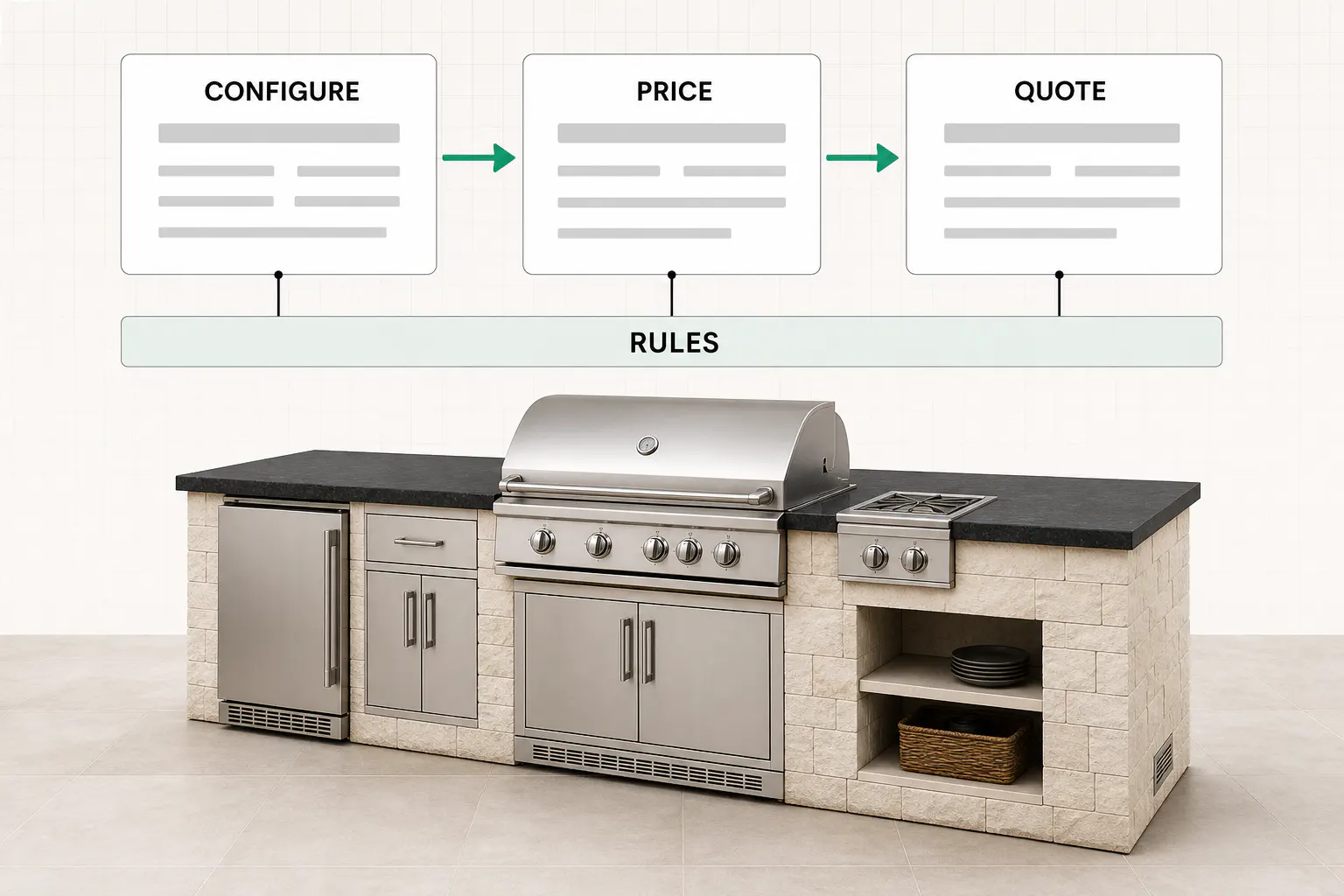
CPQ stands for configure, price, quote. It is software that builds a valid specification of a product, prices it, and turns it into a quote, in one flow. The option rules and the prices live in the system rather than in anyone's head, so every quote that leaves it is one the shop can actually build.

This guide is written for manufacturers of custom products, and most of it applies to anyone who quotes configurable work. It walks the CPQ meaning letter by letter, then the process, the software, and the benefits with sources attached. It ends on the one case the vendor guides skip: the manufacturer who sells through dealers.
Key takeaways
CPQ stands for configure, price, quote.
Software that builds a valid product spec, prices it, and turns it into a quote in one flow.
The rules and prices live in the system, not in the salesperson's head.
A quote that reaches the buyer is one the shop can actually build.
If you sell custom products through dealers, CPQ matters most where the vendors never point it.
Putting quoting in the dealer's hands without giving away your cost price.
The clock is real.
71%of manufacturers and distributors need at least a full day to produce a quote vendor-commissioned Aleran/TrendCandy survey, July 2025
39%of B2B buyers will spend $500,000 or more through self-service or remote channels McKinsey B2B Pulse, 2024
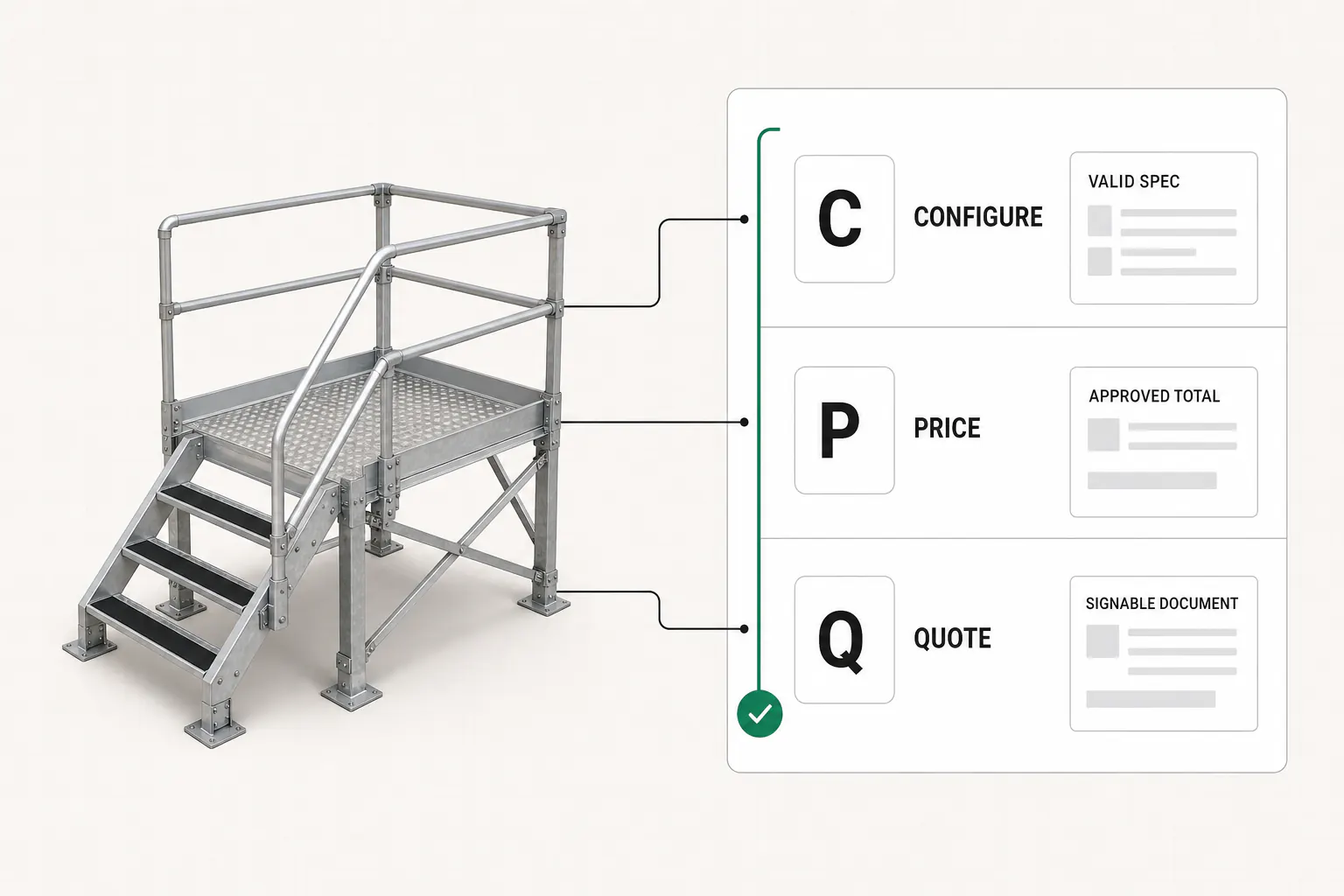
CPQ stands for configure, price, quote. The three letters are three jobs one system does in one motion, on one record of the build. Most pages answering what is CPQ stop at the expansion, so here is what each job actually does.
Configure is picking the options that define one specific build: the size, the materials, the add-ons, everything that makes the product this buyer's product. Real configuration runs against rules. Options that cannot be built together cannot be picked together, and what comes out is a specification the shop can make.
Price attaches money to that specification. The number comes from a price book: option prices, size formulas, the discounts a seller is allowed to give, and the approvals a bigger discount has to pass. Nothing is priced from memory.
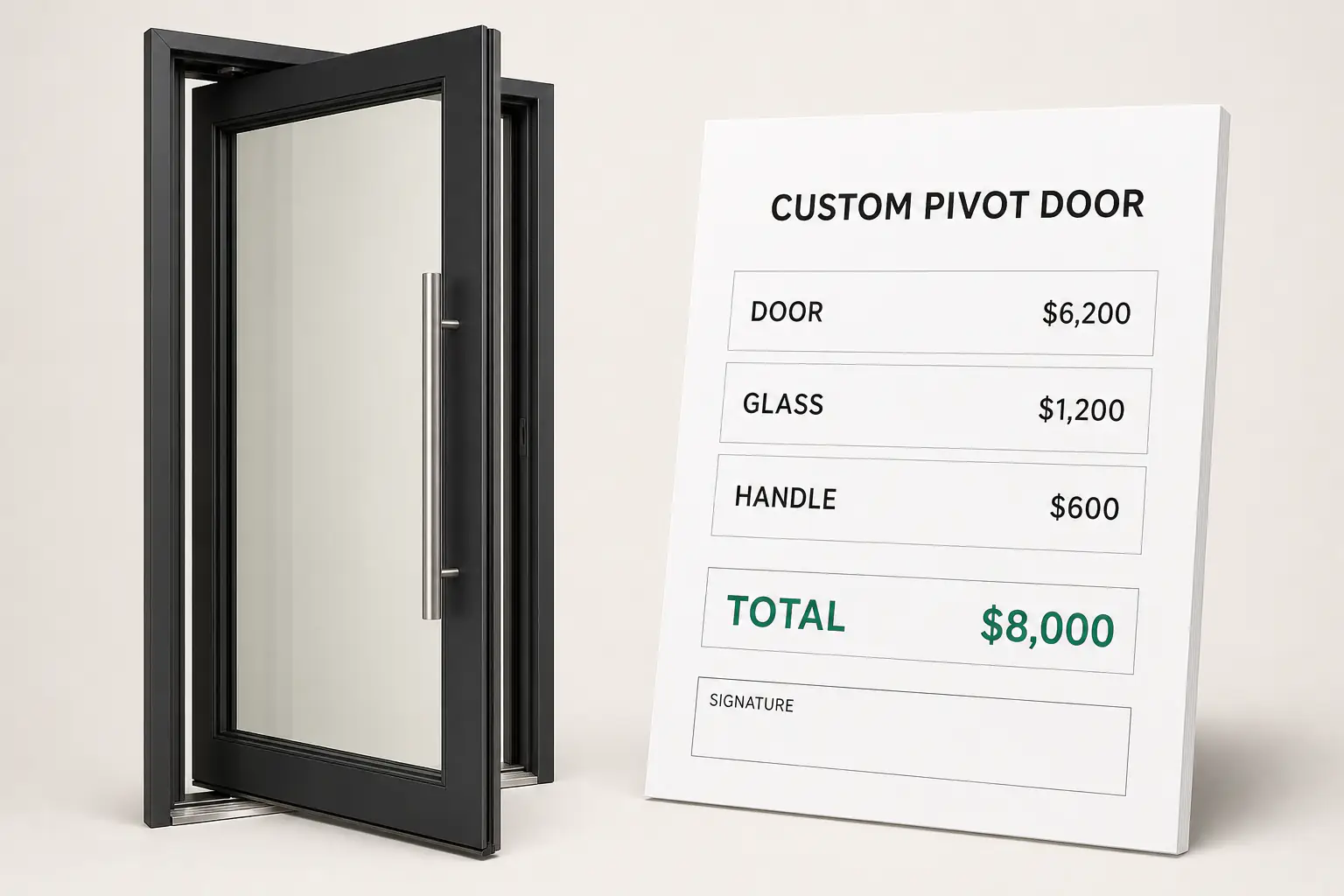
Quote turns the priced specification into the document a buyer can sign. Line items, options, the total, terms, and a validity date, all generated from the same record the rules just approved.
The point is the joining. Configure, price, and quote used to be three tools and two retypes. CPQ makes them one flow, so the specification, the number, and the document cannot drift apart. Some searchers ask the long form, what is configure price quote, spelled out. Same question, same answer. And if you want a configure price quote definition in one line: one flow, one record, no drift.

The CPQ process is the path from the first option picked to a signed quote, and its whole point is that nothing invalid survives any step. Vendors draw it as three stages. The honest version has a fourth, and the fourth is where the money is.
Configure. Options are picked against rules, so a build the shop cannot make is blocked at the click.
Price. The price book prices each option as it lands, and a discount past the limit routes to an approval.
Quote. The approved configuration becomes the document the buyer signs, generated from that same record.
Order. The signed quote becomes the order and the build sheet, with nothing retyped on the way.
Someone picks options on a screen. The rules check every click. A choice that needs another option pulls it in, and a choice the shop cannot build is blocked the moment it is made, with the reason on screen. This is the step where spec errors die, because the person quoting no longer has to know the whole product to get it right.
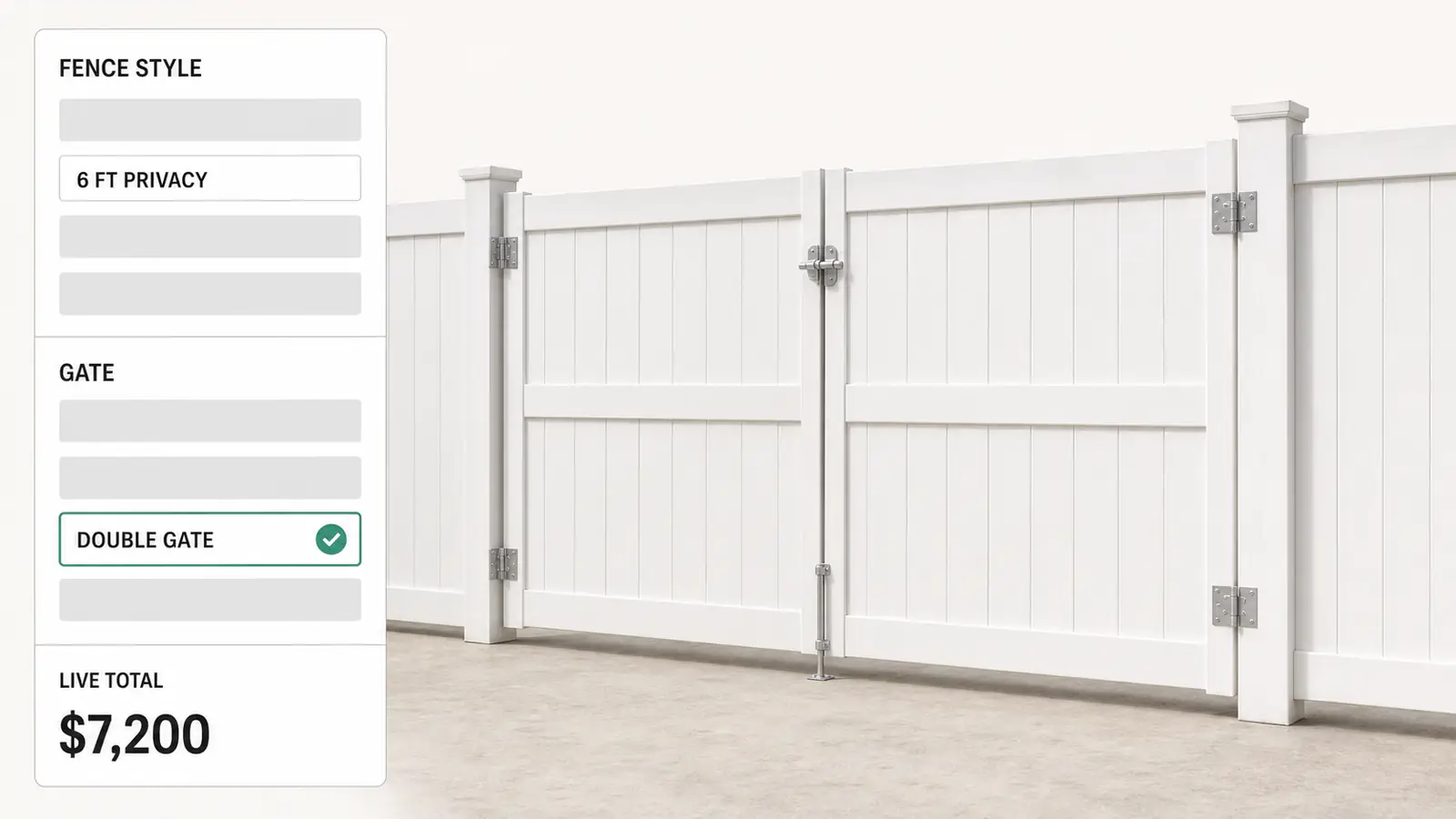
Each picked option carries its price, formulas handle the sizes, and the running total updates as the build changes. Where the seller is a dealer, the prices come from that dealer's own list, with their margin on top. A discount past the allowed line routes to an approval instead of sliding through.
The finished configuration becomes the quote: the line items, the options as picked, the total, the terms. Because it is generated from the approved record, the document cannot promise a build the rules rejected. That is the quiet guarantee the whole CPQ process makes: what is quoted is what was configured, always.
Almost every guide on this subject stops at the signed quote. Follow it one step further. The signed configuration becomes the order, and the order becomes the build sheet, with nothing retyped between them. For custom products this is the point of the whole exercise. A wrong custom build has no restock and no resell, so an error that reaches the shop costs the entire build.
There is data on where manual quoting actually fails. In July 2025, research firm TrendCandy surveyed 200 US manufacturers and distributors, in a study commissioned by CPQ vendor Aleran. The top failure points: approval workflows (53%), pricing flexibility (48%), matching customer requirements (45%), and data entry errors (44%). Read that list against the four steps above. Each failure sits exactly where a rule or a price book replaces a memory.
Take the request
Check it can be built
Price it
Discount and approve
Write the quote
Turn it into an order
CPQ works by moving the product knowledge out of people's heads and into rules the system enforces while somebody clicks through options. The seller drives. The rules ride along and say no at the right moments.
The rules read the way the shop talks. If the roof is louvered and the span passes 14 feet, require the third post. If the wall is solid, block the motor on that side. Fifty of those, written down once, outlive every hire and every busy week.
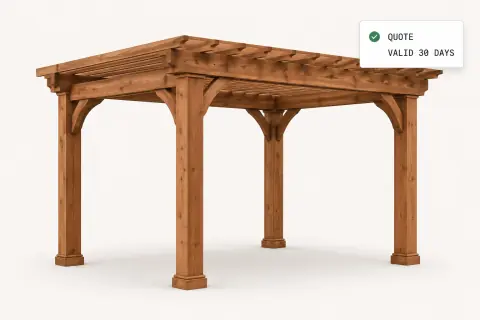
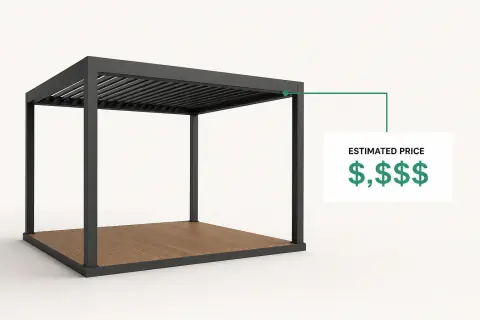
Take a worked example. The dealer picks a freestanding pergola, 12 by 16 feet, a louvered roof, and two privacy walls. The rule engine checks each click: a 16 foot span needs a third post, so the system adds it and prices it. The privacy wall is not offered on the side where the louvers open, so that combination never appears. The buyer asks for a motor upgrade, the dealer picks it, and the total moves at the moment of the click, from that dealer's own price list.
When the build is done, the quote is one more click: the configuration, the line items, the total, the terms, and a validity date, on the dealer's paper. Nobody phoned the factory. Nobody opened a spreadsheet. The one person who used to price every pergola was not interrupted, because the knowledge that lived in their head now lives in the rules.
The quote also stays a record. When the buyer comes back two weeks later wanting the taller posts, the dealer reopens the configuration, changes one option, and sends version two. Nothing is reconstructed from an email thread.
One more piece changes the conversation rather than the math: showing the build on screen, so the buyer watches the pergola change as options are picked. Vendors call that visual cpq, and it is the difference between approving a picture and approving a parts list.

CPQ software is the system that runs the configure, price, quote process. It is one place that holds the product model, the option rules, the price lists, and the quote templates, and it turns them into valid quotes on demand. You will hear the same thing called a CPQ system, a CPQ solution, or configure price quote software. The labels move; the three jobs do not.
Four things live inside it. The product model: which options exist, in which groups, at which sizes. The rules: which combinations are valid, which choices force or exclude others. The price lists: what each option costs, per customer or per dealer where that matters. And the templates: what the finished quote looks like when it lands in front of a buyer.
The price lists are where channel businesses live or die. One list per dealer or per tier means the same build carries a different number for each seller, without anyone maintaining six spreadsheets that quietly stop agreeing.
Where it sits is simple to say. CPQ is the quoting layer between the CRM and the ERP. The CRM owns the relationship and the deal. The ERP plans, costs, and schedules the job once it is real. CPQ decides what the product is and what it costs before the order exists, then hands a clean order over. Leads in from the CRM, approved orders out to the ERP, nothing re-keyed. That is the whole integration story a buyer needs at this stage.
It is an established category, not a niche tool. Grand View Research put the CPQ software market at about $3.5 billion in 2025, growing at roughly 15.6% a year. Mordor Intelligence lands in the same band: $3.63 billion for 2026, heading for $7.55 billion by 2031.
The most expensive misconception in the category is that CPQ software means an enterprise project with a months-long implementation. It does not have to. A launch can be measured in weeks when it starts with one product line, and the rest of the range follows once the first line runs.
The benefit of CPQ is not typing speed. It is that errors stop reaching production, and quotes stop waiting on the one person who knows the prices. The benefits of CPQ software show up in the order book and the shop, not on a stopwatch.
The first four come from one survey of 200 US manufacturers and distributors, run by research firm TrendCandy and commissioned by CPQ vendor Aleran, so read them as a vendor study with an independent fieldworker rather than as neutral research.
Manual quoting has a measured cost, and the figures above are all manufacturers and distributors describing their own quoting. The pattern in them is consistent. Quoting is slow, it is still manual for most, and the deals it loses are real. That gap is the one the category exists to close.
The waiting matters as much as the errors. A configured quote that takes days is not slow because anyone is lazy. It is slow because it queues for the one person who can price it safely. Put the rules and the prices in the system and the queue disappears, because the safety travels with the software instead of with a person.
Speed compounds, because quoting is not what salespeople mostly do. The last figure above comes from Salesforce's State of Sales research, a 2024 survey of 5,500 sales professionals across 27 countries. A quote that assembles itself hands some of that time back.
One warning about the numbers you will read elsewhere. Most pages on the benefits of CPQ software repeat that it delivers 105% larger deals and 49% more proposals per rep. Those claims trace to one Aberdeen Group report from around 2013 whose original is no longer retrievable. They survive as vendor blogs citing each other. We could not verify them, so this page does not use them. The numbers above are the ones with retrievable sources.

CPQ pays where the product has enough options that a price list cannot hold it, and where a wrong specification is expensive. Both conditions matter. Manufacturing is the category's largest vertical, at 32.12% of 2025 CPQ revenue per Mordor Intelligence. That is not an accident: configurable physical products fail both tests at once.
You can self-diagnose with four signs. Every quote routes through one expert, and waits for them. Spec errors reach the shop often enough to have a nickname. Dealers wait on the factory for prices they should be able to look up. And a quote takes days for a product a buyer decides on in minutes.
The products this describes are the ones this guide is written for: pergolas, saunas, outdoor kitchens, cabinets, sheds, trailers, machinery, windows and doors. Anything sold as options on a base, where two builds are never quite the same.
The honest non-fit: a fixed catalog with three options does not need CPQ. If every product has a SKU and the price never depends on a configuration, a price list and a webshop already do this job. CPQ there would be process for its own sake.

CRM tracks the deal, ERP runs the business, CPQ builds the quote, and a product configurator is the front half of CPQ. Four systems, four different questions. The cards below draw the lines the sales pitches blur.
CRM
ERP
CPQ
Product configurator
The last row is the one the vendor guides skip, and it is the comparison most buyers actually need. A product configurator is the choosing screen: it produces a valid build and stops. CPQ is what happens when the price book, the approvals, and the quote document are attached to that screen. When the build itself needs to be seen to be sold, the configurator half grows into a 3d product configurator, and the quoting half does not change. The choosing half also has a pillar of its own now: what a product configurator is, told the same plain way this page tells CPQ.
And if your product is configurable and your channel is dealers, the category to read next is cpq software for manufacturing. The same three letters, applied to the shop floor and the dealer network rather than to a SaaS sales team.
For a manufacturer who sells through dealers, the quoting seat is the dealer's, and that changes what every letter in CPQ means. Every ranked guide on this subject assumes the person quoting is the software buyer's own sales rep. In a dealer channel that assumption is simply wrong.
Configure becomes rules the dealer cannot break. The dealer builds the product in front of the buyer, and your constraints ride along. A dealer three time zones away cannot promise a build your shop will refuse. Price becomes that dealer's own list with their margin on top. The buyer sees one finished price, the dealer sees their price and their margin, and your cost price never leaves your side. Quote becomes a document the dealer sends under their own name, without waiting on your office.
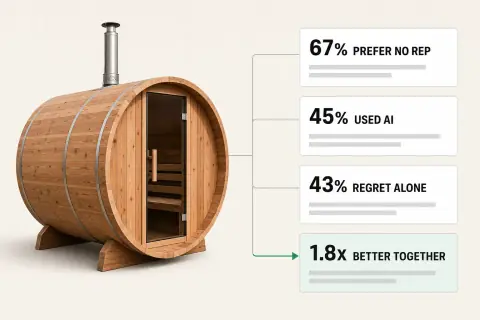
The buyers are already there. A Gartner survey of 646 B2B buyers, fielded in August and September 2025, found 67% prefer a rep-free buying experience. McKinsey's B2B Pulse, a 2024 survey of 3,942 B2B decision makers, found 39% willing to spend $500,000 or more through self-service or remote channels. That is up from 28% just two years earlier.
B2B buyers willing to spend big without a rep
The channel is moving the same way. Digital Commerce 360 measured US B2B ecommerce at $2.93 trillion in 2025, up 13% in a year in which total US B2B sales grew 0.4%. The buying is moving to screens far faster than the market is growing. The dealer who can quote on a screen is the dealer who gets the deal.
In practice this runs on two pieces. The sales configurator is what the dealer drives with the buyer in front of them: the build, the price, the quote, in one sitting. The signed-in home for all of it is a b2b customer portal, where each dealer opens on their own prices, their own margin, and their own orders. Your factory sees valid orders only. The CPQ system is what makes that safe. It enforces your rules and your price boundaries while the dealer drives, and handing away the quoting seat never means handing away control. That is CPQ with the letters in the dealer's hands, and it is the version of this category nobody above this page writes about.
Short answers to the questions people actually search. The first sentence of each is the answer.
No. A product configurator is the choosing screen, the front half of the C in CPQ. It produces a valid specification of the build. CPQ adds the price book, the discount and approval logic, the quote document, and the order trail behind all of it. Most manufacturers end up wanting both halves, which is why the two usually ship as one system.
A CRM manages relationships and deals. CPQ builds the quote inside the deal. The CRM knows who the buyer is and where the conversation stands, and it has no idea which option combinations your shop can build or what they cost. The two connect rather than compete: the lead lives in the CRM, and the priced configuration comes from CPQ.
There is rarely a public price list, because no two setups match. A maker with a few signature builds and a handful of dealers is a different project than a deep product line sold through a large network. Dealect prices for the manufacturer, and dealers pay nothing. The figure is shaped by three things: the products and rules to model, the dealer count, and the pieces you add. You hear the full number on one 30-minute call.
Weeks, not months, if you start with one product line. You hand over the option list, the rules your shop builds to, the price lists, and the dealer list. The vendor models them, and the first line is usually live within a month, with the rest of the range following once it runs. Enterprise CPQ projects do run longer, and that is a property of those projects, not of the category.
No. The enterprise reputation comes from where the category grew up, not from what the software does. The mechanics matter most where the quoting knowledge sits in the fewest heads, and that is usually a small manufacturer. If one expert prices everything and a wrong spec costs you a whole build, CPQ pays long before you look anything like an enterprise.
Yes. In dealer-facing CPQ this is standard, and it is most of the reason the setup exists. Every dealer works from their own price list and watches their own margin while they configure. The buyer sees one finished price, your cost price never leaves your side, and no dealer ever sees another dealer's numbers.
Last updated
That is the CPQ meaning in one page. Three claims worth carrying out of it:
If your next question is what a configurator costs, the honest structural answer is on the pricing page. And if it is faster to just watch one of your own products get quoted this way, that is what the demo below is.
Teodoro Pickett writes the Dealect blog, covering CPQ, product configurators, and the business of selling custom products through dealer networks. Every article is written for manufacturers first, checked against sources a reader can open, and updated as the category moves.
Request a 30-minute call, bring one product, and see it configured, priced, and quoted live. We reply by email to set up the time.
Your call is with the Dealect team.